
Nest-Besmirchers
Mann, "key-novels," autofiction, and the Google-compulsion

Dear friends! Since last time, I have not only finished Famesick and The Magician, but I am also back from the Thomas Mann tour of Lübeck, which turned out to be incredibly thought-provoking from an autofiction perspective—far more so than I expected, since Thomas Mann isn’t the first name I associate with autobiographical fiction, and Buddenbrooks isn’t the first novel I associate with Thomas Mann. But you know who did associate Mann with Buddenbrooks and autofiction (though of course they called it something else, viz. Schlüsselroman, a.k.a. roman à clef, a.k.a. “key-novel”), is the merchant class and wider community of Lübeck, to an extent that is still palpable today, 150 years later.
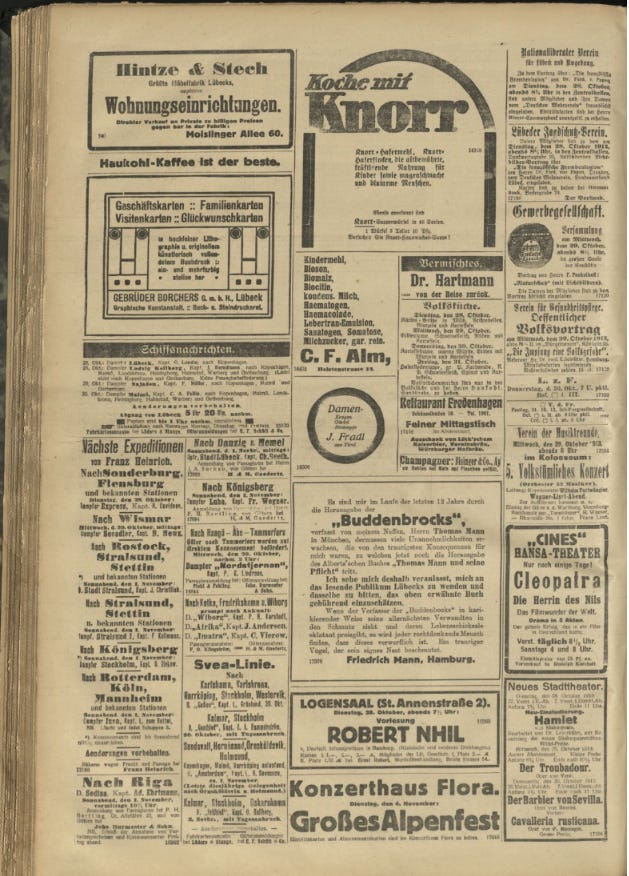
Before my visit, I hadn’t quite realized the extent of the scandal created in Lübeck by Buddenbrooks—not just on publication, in 1901, but for decades afterwards. This photo shows our tour guide standing in front of Manns’ grandparents’ house on Mengstraße, holding a reproduction of a 1913 ad placed in a Lübeck paper by Mann’s uncle Friedrich, denouncing Thomas as an author who “drags his own closest relatives through the mud in a caricaturing manner and flagrantly exposes the intimate details of their lives.”
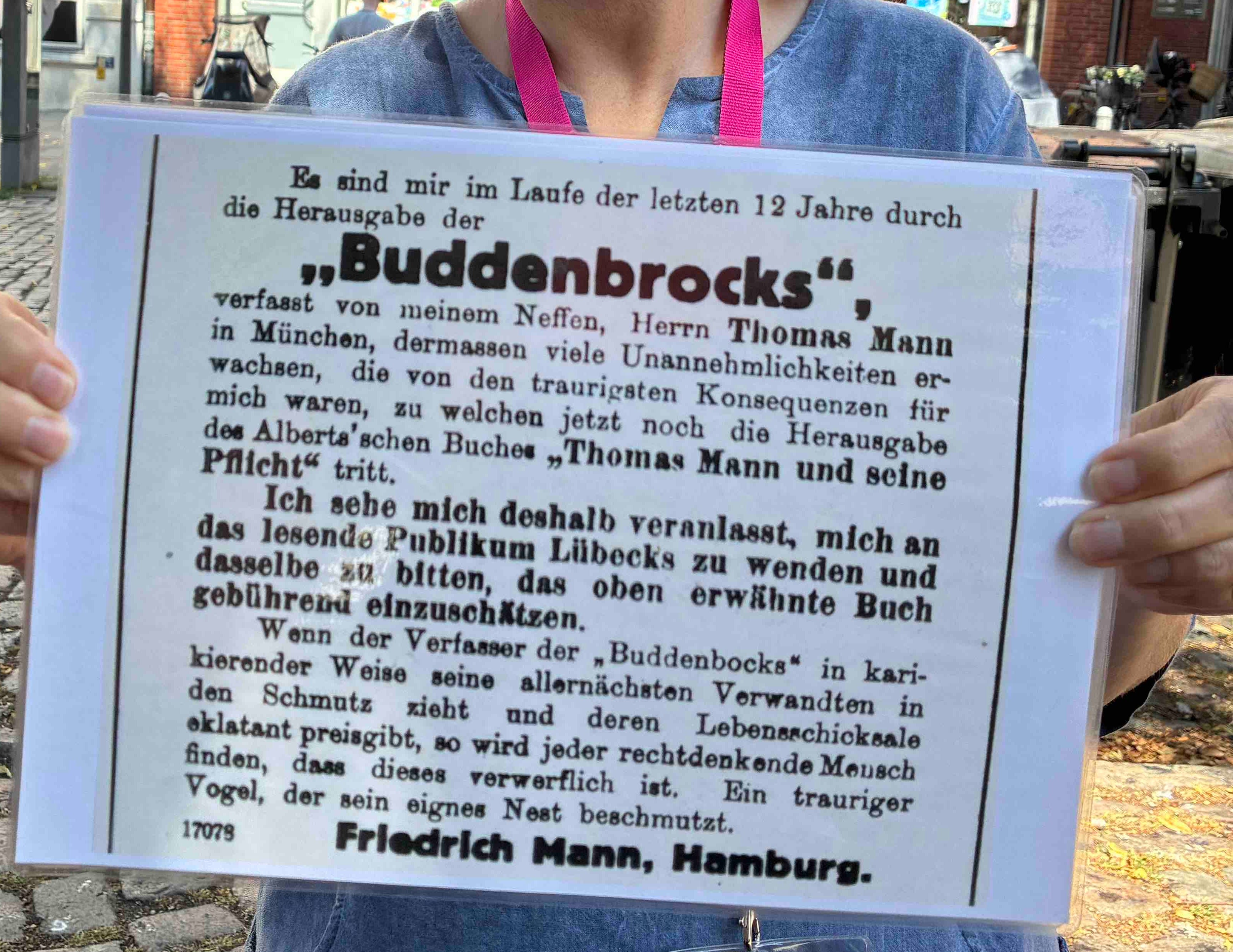
The only sentence I understood in German was the last one: “A sorry bird that besmirches its own nest.” And in fact, one term that was leveled at Mann during this time was Nestbeschmutzer: nest-besmircher.
I was likewise horrified to learn that, as soon as the novel was published, Lübeckers started making “key lists” (Schlüsselliste), mapping the characters against their suspected models. The archivist at the Buddenbrookhaus told us that people would compare lists with friends, in order to fill in missing characters; booksellers would sometimes slip customers a copy of the list, along with the book. (The Buddenbrookhaus archive holds some 19 of these lists.)
So OK, here is the thing I want to write about. I just said I was “horrified”—and it’s true, I was horrified—and yet… the whole thing was also sort of hilarious. I have some pictures of us all looking at Uncle Friedrich’s ad, and everyone in our group—organized by Christine Lehnen of the University of Hamburg, and by her amazing grad student, Bita—looks delighted, even me.
When it comes to people’s efforts to identify the real models of fictional characters, or of unidentified intimate characters in memoirs, I have two contradictory sets of emotions. As a writer, I am filled with aversion and horror. As a reader, though, I totally get it. While listening to Famesick, I was constantly Googling people, apparently in a zombie-like semi-conscious state, because later I would look at my phone and be like, “Why is it open to an image search of some guy,” and then I would remember, “That’s Jenni Konner’s ex-husband, whose Hinge date diagnosed Lena’s hypermobility disorder.”
So my two questions for today are: (1) “Why do we, as readers, feel compelled to learn real-life information about literary characters,” and (2) “Why is this compulsion so horrifying to me as a writer.”
Coming up after the paywall: a 4000-word essay on this subject, with reference to Mann’s text “Bilse and I,” in which he responds to nest-besmirching allegations.
Thank you!
